


As we head into the holiday season, I'm going to post a series of "survival" tips. You are probably very familiar with the stress-reduction suggestions that usually appear everywhere this time of year. But hopefully, these will serve as a reminder.
So what is H.A.L.T.?
HALT is an acronym that serves as a relapse-prevention tool people in early recovery from alcohol and drug addiction have in their repertoire. It's a handy reminder of behaviors/states of minds/situations that are triggers to relapse. But it doesn't just apply to addiction, it can work for all of us.
H - Don't Get Too Hungry
Hunger can be a trigger to drink or use. But how many of us starve ourselves in anticipation of a holiday event and then binge when we get there?
A - Don't Get Angry
When we aren't in control of our emotions, it can lead to unhealthy and/or nonproductive behaviors.
L - Be Careful of Being Lonely
Isolation and social withdrawal is often a precursor to relapse. It is also a symptom of depression and some types of anxiety. Spend time with people who support you.
T - Don't Be Too Tired
Be careful of wearing yourself out. Most of us can make bad decisions when we are overly tired.
HALT is a simple tool, but an easy way to remember some very effective means of self-care during the holidays.
Nancy L., LISW, LICDC
Strategies for Surviving the Holidays - H.A.L.T.

10 Tips to Kick Holiday Stress-Management into High Gear

Hanukkah began yesterday at sundown. Christmas, Kwanzaa and Boxing Day are three weeks away. The holiday crunch is on us: time for a refresher in slowing it down, regaining our focus and getting re-grounded.
- Quit trying to find the "perfect" gift. The teenagers in my life are all getting gift cards from a retail store. Teens like those almost as much as money. Your picky mother-in-law won't appreciate the time you took to select her gift - and she still won't like it. So don't stress about it.
- Avoid high-traffic times if possible. Drivers are terribly distracted this time of year. Add that to inclement weather and you have an accident waiting to happen. Stay out of stores at peak times. I call it "shopping psychosis," that look that comes over people as they block store-aisle traffic with their carts. Stay home and order holiday items and gifts online; you still have time.
- You do not have to entertain this season. Give yourself permission to NOT have people over for parties, etc. Unless you can afford to cater the event, have a cleaning service and/or it's already in the works - just don't do it. And not worrying about the mess can be very healthy.
- Watch your breathing. Most of us don't breathe enough normally; we take shallow breaths and deprive ourselves of oxygen. Add stress to that and we can even become light-headed. Sit in a quiet place, close your eyes and take 10 deep breaths. Inhale slowly and exhale more slowly. You'll be amazed at how relaxed you will feel!
- Get enough rest. I have patients tell me that they only sleep 4-5 hours a night. Most research would say they are sleep-deprived. Cut out some TV or computer time at night and get some sleep. And naps are not just for cats. Try one or two...
- Make sure you have some quiet, alone time scheduled. The social demands of holiday seasons are high. We are required to interact more with family, co-workers, etc. That can be very tiring, especially if socializing causes you anxiety. Factor in some down-time.
- Watch alcohol and food intake. I am not setting a good example by sharing my potato-chip mini-binge above. Spiked eggnog, wine, drinks and high-fat, high-caloric food abound this time of year. Denying yourself any treats this season isn't necessary. But try to eat healthy foods, too.
- Plan one fun event just for you. You probably spend much time and effort insuring others are taken care of and entertained this season. Remember to treat yourself - get a manicure, go to a heated driving range, babysit a friend's new puppy or read that new best-seller you've been hoarding.
- Watch a favorite holiday movie or show. In an earlier post, I mentioned the film Home for the Holidays. It's great if you want to laugh at family dysfunction. But I'm talking about a sentimental favorite. It's corny and dated, but I love Holiday Inn. Bing Crosby singing "White Christmas" does it for me.
- Get some exercise. Most usual exercise routines get abandoned this time of year. We are full of excuses. But exercise is a terrific stress-buster. Take a walk in the snow with your kids or dogs.

Related posts:
Holiday Stress-Reduction Tips - Listen to the Real Experts
Set Realistic Expectations for the Holidays
Strategies for Surviving the Holidays - H.A.L.T.
Light Therapy Pros and Cons
 The Mayo Clinic has an excellent article on the use of light therapy for treatment of Seasonal Affective Disorder, depression, obsessive compulsive disorder and some sleep disorders. The article includes the benefits and side-effects of using light boxes as well as instructions on using a light box. Please note that this post includes affiliate links to products we like. Purchasing these products will not cost you any more but we may earn a commission from your purchase.
The Mayo Clinic makes the point that the effectiveness of using light boxes vary, from being as good or better than medications for some people, while others get little or no benefit. This is possibly due to the large range of light boxes available and the different theories on the appropriate spectrum of light to use and the duration of treatment.
Light boxes can be expensive to purchase, however it is also possible to rent them on a trial basis to see whether they are effective for you. The Apollo GoLite box is a popular model that a lot of people have recommended (I've never used one as I find the winters here are quite mild and I can usually get enough natural light to keep depression at bay). In addition to using the light boxes there are also special light bulbs and desk lamps you can purchase.
Some of the features to look for in a light box are:
- Durability
- Rechargeable batteries e.g. Philips goLITE BLU Light Therapy Device
- International adaptors (or chargeable via a USB or other device) for international travelling e.g. Syrcadian Blue SB-1000 Sad Light Therapy Device
- Portability for taking to work or use in different rooms in the house
- Battery life
- Bulb life
- Bulb replacement cost
- Timers
Once you have purchased the light box, most models will last a few years, but it pays to check out the replacement at the end of this time. Some will allow you to replace the bulb, other models require you to replace the entire box which can be costly. However, if you don't have insurance the light box can still be cheaper than medications without the stigma or side-effects of anti-depressants.
You can purchase models with rechargeable batteries which are ideal for travelling, or units that use power cables. You can even purchase a model that is powered by the USB in your laptop or computer, such as the Syrcadian Blue SB-1000 Sad Light Therapy Device.
Some people get instant relief from using their SAD light therapy box while other people find it takes a few days or up to a week to notice any improvement.
This doesn't mean that light boxes don't have side-effects, however most people find them tolerable. Some people with bipolar disorder may experience manic episodes, while others may find that the light box affects their skin, or induces headaches or eyestrain but the majority of people that I've spoken to have nothing but praise for their light box. Most of these side-effects last only a few days but if you are experiencing problems, discontinue the use of your light box and check with a medical professional.
For the full list of light therapy devices (including lights to wake you in the morning!) click here.
This post includes affiliate links

Quiz Top 5 Signs Your Feelings Are Making You Fat by Colette Baron-Reid

Quiz: Top 5 Signs Your Feelings Are Making You Fat
by Colette Baron-Reid
- You feel disconnected and disoriented by strong emotions during family encounters, and you turn to food to calm down.
- During stressful times, you can gain weight without eating extra food.
- In your experience, fear and excess food go together.
- When you feel emotionally unsafe, food is temporarily calming and makes you feel grounded and secure, if only for a few seconds.
- You feel powerless when you’re in an emotional eating phase and powerful when you think you’ve got it handled.
Can you relate to these statements?
If you agree with even three out of the five signs above, your feelings are making you fat.
What I mean is your empathy is probably interfering with your ability to lose weight and keep it off.
You might be thinking, Great, now what? Do I just stop caring? Sort of, but it’s not that harsh. You don’t need to become an Ice Princess to maintain a healthy weight.
I know from whence I speak. Food sealed my porous boundaries where other people’s energy invaded me, and it allowed me to feel present in myself. I needed that quiet and calm, but I had to find a better way to achieve it. This revelation ended an exhausting war with food which was an incredible feat, given how much I have struggled with all of this over the years. It all began with understanding why I was feeling too much and why fear and frustration were making me fat.
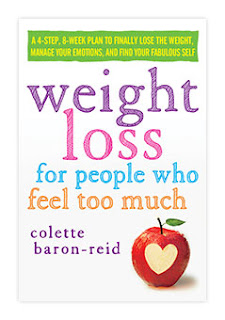
If you know you need support with setting healthy boundaries, order my book Weight Loss for People Who Feel Too Much: A 4-Step, 8-Week Plan to Finally Lose the Weight, Manage Emotional Eating, and Find Your Fabulous Self and you will receive a free online home study class with a support forum called Jump Start that will give you wonderful guided meditations to help reduce stress and manage your emotions as well as a community forum that includes trained coaches and past participants to help you! (You might even drop a few pounds too!)
If you act quickly - you will also be in the draw for some fabulous prizes including a spa weekend getaway, a full weight loss coaching and nutrition program, a brand new Kindle Fire and more!
Buy the book now then head on over here to enter the draw.
This is a guest post by Colette Baron-Reid. For more information about Colette's book and the prize draw click here.
Balancing Work & Family Life - Is it Possible?
 I may not be my most objective on this topic as I've just returned from my first real vacation in over three years. The current state I call "Post-Vacation Re-Entry Syndrome" - going from watching sunsets on the beach to shuffling through stacks of bills and returning work phone calls. But while away, my husband and I vowed to try harder to achieve a similar disconnect from work while back to the realities of everyday life.
There are masses of information out there on the topic. When I Googled "balance in work and family life," I got over 44 million hits! With so much written about it, why is it so hard for us to implement that balance? Here are some helpful ideas to address the issue.
A very comprehensive book on the topic is Robert W. Drago's Striking a Balance: Work, Family, Life This is not the usual bullet-ted, self-help easy read. Drago is a professor of Labor Studies  and Women's Studies at Penn State University. Although a more scholarly treatment, with much exploration of various theories, it is very readable. Washington Post.com's Leslie Morgan Steiner has an excellent work-life blog. Every Tuesday, she invites a guest to write about their experiences trying to achieve life balance.
Another good resource is the newspaper Web site The Wall Street Journal's CareerJournal.com. A recent article by Jonathan Clements focused on achieving happiness.
Much of the literature addresses childcare topics. How do parents achieve a balance in their work and parenting lives? Personally, I become a little frustrated when most of the focus seems to fall on mothers achieving this balance or more often failing to achieve this balance, which has a very blaming feel. I wish there was more focus on how fathers are affected. An interesting exploration of the topic is this piece from Inc.com, "Working Moms and Dads Clash on Work-Life Balance".
Take some time to examine your own work-life-family relationships. If they feel out of whack, begin to take steps to achieve that balance. If your situation feels particularly overwhelming or if you are experiencing burnout or other stress-related responses, professional help may be indicated. Fortunately, many companies now offer EAPs, Employee Assistance Programs. Through these programs you can access professionals who can help, most often at no charge.
Nancy L., LISW, LICDC
Clothing Size Maketh The Woman
What’s more important to you - buying clothes that fit you well or the label size of those clothes?
You may be surprised to find that in a recent survey by a clothing alteration firm that Australasian customers, and in particular women, would opt not to purchase clothes that fit them well, if the label says it is in a larger size than their usual size. When you consider that most clothes don’t have the size label on the outside, why are we so worried about this invisible measure?

I’m sure a lot of readers can relate to the thrill of finding that they can fit into a smaller size of jeans, and the disappointment when their usual size doesn’t fit. Some people use it as a form of motivation – they intentionally purchase clothing that is too small for them in the hope that this will inspire them to lose weight, but others do it because they can’t bear the thought of purchasing a larger label size.
Canny manufacturers recognising the psychology of clothing sizes often opt for roomy clothes and increasing the measurements to allow people the comfort of purchasing clothes in a smaller label size. This is on top of adjustments that have been made to accommodate the growing girth of the population.
Experts estimate that today’s size clothing in New Zealand is approximately 5cm (2 inches) larger than the same label size 20 years ago.
Two-thirds of customers surveyed by clothing alterations chain LookSmart said they owned clothing in different sizes, and half said sizing variations made them feel frustrated, depressed - or fat.
Mr Hatoum said inconsistent sizing was demoralising to shoppers, many of whom were unwilling to change sizes for emotional reasons.
Hatoum sums it up neatly when he says,
"A size tag is more than a number - it relates to how people see themselves."
So what is the solution? Some in the industry want to see standardised sizing across all apparel manufacturers, but I think the real answer lies in not becoming overly attached to the clothing size label. Scales and clothing sizes are useful measures to help you track your progress toward your goals, but when you get on the rollercoaster of feeling good or bad about yourself depending on the result of those measures, they become self-esteem killers.
If you can learn to be confident and happy with your body and opt to purchase clothes that are comfortable and fit well it will be one less trigger to emotional eating, which can stop people from losing weight and keeping it off.
Overbooked Kids
 My therapy practice includes quite a few adolescents, mainly high school students. Lately, I've been amazed at how packed their schedules are. They practically have to pull out a PDA to make an appointment! When I asked one yesterday if things were winding down before the holidayr break, she looked at me like I had two heads. Evidently, the teachers are piling it on.
Of course, I can't be entirely objective about this topic. I'm a mental health professional and the kids I see are usually being treated for anxiety, depression, substance abuse, etc. So I'm looking for any causes for the pathology I'm seeing.
In an article in Psychology Today, The Overbooked Child, psychologist David Elkins talks about the stress and depression he sees in his young patients. After interviewing his patient Kevin (not his real name) and his mother, the mother dismissed the idea that her son was stressed. She maintained that he enjoyed all the activities in which he was scheduled.
"But Kevin wasn't having a good childhood. He was overscheduled and on the brink of clinical depression. When I talked to him on his own, he confided that he missed playing with his friends in the neighborhood. They used to ride bikes, have water-balloon fights and build forts out of cardboard boxes. Now there wasn't time for those activities. 'I really like being in sports and everything,' he said. 'But not all that much.' "
In the book, The Over-Scheduled Child: Avoiding the Hyper-Parenting Trap, authors Alvin Rosenfield, M.D. and Nicole Wise discuss this issue. Rosenfield believes it's the parents who are driving this, "it's how we parent today."
"Parents feel remiss that they're not being good parents if their kids aren't in all kinds of activities. Children are under pressure to achieve, to be competitive. I know sixth-graders who are already working on their resumes so they'll have an edge when they apply for college."
When I've asked them about their schedules and whether their parents are pushing it, I often here that most of the activities, including enrolling in AP courses, are their choice.
On the Web site FamilyEducation.com, they suggest ways to help your kids work towards a balance in their activities:
Help Your Kids Strike a Balance
- Help your child set priorities.
- Help your child develop a realistic schedule to accommodate family, school, sports, and everything else.
- Find out at the beginning of the season what the coach's expectations are for the team.
- Let the coach know about your child's other commitments.
- Encourage your child to get homework done early in the day.
- Set aside a certain period every day for quiet study.
- Watch for signs of burnout, i.e., falling grades, diminished interest in other activities, and fatigue.
- Work with coaches and school officials to minimize sports interference with academics.
- Be a good role model: set priorities for yourself and stick to them. Point out athletes who maintain good grades.
This last point is critical. If you, as a parent, are so overscheduled yourself that you can't make time to discuss a healthy balance with your kid, that's an indicator of a problem. I'm amazed when I ask parents to schedule an appointment with me to discuss their child. I will often hear an incredulous, "Both of us?!" That always tells me very important information about the family's priorities. And yes, I insist that they both make time to come in.
Nancy L., LISW, LICDC
Will Work for Food: How Food & Money are Linked
Guest Post By Wray Herbert Director of Public Affairs for the Association for Psychological Science.
 The words are often scrawled on a piece of cardboard and always painful to read, because they remind us of life’s fragility. They also pluck a deep chord in our psyche, because they reduce life to our most fundamental needs. After all, the sentiment behind those poignant words can be traced all the way back to the African savannas, to a time when our earliest ancestors did indeed do just that. In the eons before minimum wages and credit cards and 401-Ks, the closest thing to earnings and savings was bounty from the hunt. Food was more than nourishment; it was an asset.
Given this deep and ancient connection, it’s not implausible to think that food and money might still be tightly intertwined in our psychology, even deep-wired in our neurons. And in fact, behavioral scientists are very interested in the links between scarcity and hunger and gluttony on the one hand, and frugality and charity and stinginess on the other. Put simply: Could comfort food translate into feelings of financial security? Might there be a link between satiety and generosity? Can we literally be hungry for money?
Psychologists at Katholieke Universiteit Leuven in Belgium decided to explore this dynamic in the laboratory. Barbara Briers and her colleagues did a series of three experiments designed to tease apart the connections between nourishment and personal finances. In the first, they deprived some people of food for four hours, long enough that they wouldn’t be starving but they would almost certainly have food on their mind. Others ate as usual. Then they put all of them in a real-life simulation where they were asked to donate to one of several causes.
Those with the growling stomachs consistently gave less money to charity, suggesting that when people sense scarcity in one domain, they conserve resources in another. Put another way, people with physical cravings are in no mood to be magnanimous.
In the second study, Briers actually let the participants eat as usual, but with some she triggered their appetites by wafting the scent of baked brownies into the lab. Then they played a computer game that, like the earlier simulation, tested their generosity.
Again, those with food on their minds were less willing to part with their cash. Interestingly, in this study none of the participants was actually hungry, meaning that the desire for brownies alone was powerful enough to make them into tightwads.
 That’s pretty convincing evidence. But the psychologists decided to look at it the other way around. That is, they wanted to see if a heightened desire for money affected how much people ate. They had participants fantasize about winning the lottery, but some imagined winning big (25,000 euros) while the rest thought about a modest prize (25 euros). The researchers wanted the more outlandish fantasy to increase desire for money, so they had the winners further fantasize about what this imaginary windfall would buy them—sports cars, stereos, and so forth. They basically made some of the participants greedy and not others.
Then they had all the participants participate in a taste test of two kinds of M&Ms, although unbeknownst to them the scientists were actually measuring how much they ate. And yes, the greedy people scarfed down significantly more candy. It appears that the desire to accumulate money (and stuff) is a modern version of the ancient adaptation to accumulate calories. (For what it’s worth, people who were watching their weight did not break their diets, even if they were salivating for a large-screen TV. So perhaps we are not complete slaves to our evolutionary instincts. )
 This final experiment is consistent with a classic study from the 1940s. In that study, poor kids consistently overestimated the size of coins, while rich kids did not. The new findings are also consistent with earlier research showing that poor men prefer heavier women. With both the poor kids and the poor men, financial insecurity was powerful enough to distort something as fundamental as perception.
The Belgian scientists (who report all three studies in the November issue of Psychological Science) speculate that all of this is wired into the brain.
Both food and money are rewards, they give pleasure, and it’s possible that both (and perhaps other rewards as well) are processed in the same clusters of neurons devoted to savoring rewards.
Whatever the underlying neurology, the findings could help explain a phenomenon that has long perplexed public health officials: the high prevalence of life-threatening obesity among society’s most disadvantaged.
It seems counterintuitive that those with the least money should be eating the most. But it may be, Briers suggests, that material success has become so important that when people fail in their quest for money, they get frustrated and their brains switch between two intertwined rewards. In effect, they're reverting back to a primitive state, when high-calorie food was the common currency. So those living hand to mouth do indeed work for food, but unhappily just not nutritious food.
For more insights into human nature, visit the Association for Psychological Science website.
Book Review: The Millionaire Next Door

by StanleyThomas, William Danko
According to authors Stanley and Danko there are seven wealth factors that set the wealthy apart from the rest of the population - and it isn't fancy cars, cigars and pinkie rings!
Check yourself off against this list and see if you've got what it takes…
- Millionaires live well below their means
- They allocate their time, energy and money efficiently in ways conducive to building wealth
- Millionaires believe financial independence is more important than displaying high social status
- Their parents didn't provide economic out-patient care i.e. they were left to make and correct their own financial mistakes
- Their adult children are economically self-sufficient
- They are profiicent in targeting market opportunities
- They chose an occupation that they enjoy and that best suits their talents
This book has now spawned other titles including Millionaire Women Next Door
6 Steps to Feel Good About Your Body

Here is an excerpt from her book, with 6 tips to feeling beautiful today! You'll notice that Sarah Maria's approach is very spiritually oriented, encouraging you to feel good about your body and befriend it.
P.S. if you purchase the book from Amazon, Sarah Maria has a special surprise for you including lots of free bonuses and the chance to go in a draw to win a magical meditation retreat with Deepak Chopra at the Chopra Center for Well-being. Scroll down to the end to find out how to claim your free gifts.
6 Tips to Feel Beautiful Today! By Sarah Maria
How many times have you waited for something to change so that you could finally start feeling beautiful?
If you are like most women, the answer is “all the time.”
Here is the problem: most of us tend to live with the delusional belief that we somehow need to change in order to be beautiful. It usually sounds something like:
When I lose this extra weight, then I will be attractive.
If I can just get my abs a little more toned, then I can wear that bikini I love.
I feel so much better after I put on my make-up in the morning.
I looked much sexier before I had these wrinkles.
My hair looks drab and lifeless until I get it colored.
Unfortunately, we think these stories, these lies, that we have been taught are true. We believe that we somehow need to change who we are, how we look, and what we do in order to finally be sexy, attractive, and drop-dead gorgeous.
This is a lie – an erroneous, ubiquitous, and often painful lie. The truth of the matter is that you are inherently, unconditionally, and absolutely beautiful and loveable right now, without changing a single thing.
Fortunately, very fortunately, you can expose these lies and choose to no longer live under their spell.
Ready to get started? Here are 6 simple and sure-fired ways to help you feel beautiful today:
1.Become aware of what you are thinking.
Simply become aware of the stories you are telling yourself so that you are no longer reacting on auto-pilot. Through awareness alone, you can begin to transmute your reality and transform lies into truth. Actively acknowledge that there is no inherent truth in the belief that you need to change something about yourself in order to be attractive. Consider that you can start feeling beautiful immediately, in this moment, without changing a single thing.
2. Set an Intention to See Beauty
Setting an intention is simple: intend to create a different reality for yourself. Here are some examples:
I intend to experience my inherent beauty. Or: I intend to see my beauty and perfection at all times. Or: I intend to know I am inherently beautiful, lovable, and worthwhile.
Do you ever see your reflection in the mirror and grimace at your wrinkles, vowing to purchase the latest anti-wrinkle cream?
Set an intention to find your beauty in your reflection.
Or when you undress, do you ever suck in your stomach, berating yourself for not yet losing those 5 extra pounds?
Set an intention to appreciate the body that you have right now.
Do you ever go shopping for clothes and wish you were a size (or more) smaller?
Set an intention to unconditionally accept your body.
Hopefully you get the idea; set an intention to see yourself through the eyes of beauty.

3. Take a “Meditation Moment”
Meditation is the mental equivalent of brushing your teeth. This means that it is an essential and indispensable daily activity designed to help rest and rejuvenate your body, cleanse your psyche, awaken your spirit, and help you live a life that you love.
Nourish yourself with instant meditation moments throughout the day.
Are you waiting at the bus stop on your way to work? Close your eyes and take a few deep breaths, allowing yourself to connect within.
Are you making dinner for the family? Take 30 seconds and focus on the sounds, smells, and sensations in your environment, letting them nourish your senses.
Are you in the shower, getting ready to start your day?
Turn your attention to the feeling of warm water cascading against you, gently caressing your body, and allow yourself to relax.
These meditation moments can happen anywhere, anytime – 30 to 60 seconds of closing your eyes and connecting within can make all the difference in the world.
4. Your Body is Your Best Friend
Your human body is your truest ally. Befriend it and it will serve you tirelessly.
Treat it as you would a dear friend:
Feed your body with healthy food, taking the time to give it proper nourishment.
Remember to exercise, and make it enjoyable. If the gym makes you cringe, opt for yoga, Pilates, dance, or good old walking. Anything to get your body moving will do wonders.
Relaxation is key. In our harried and hurried world, it is essential that you remember to relax and rejuvenate.
Instead of critiquing your body for not being enough of this and for being too much of that, offer it gratitude and appreciation for it unwavering support and devotion.
5. Create Meaningful Moments
Every day is filled with countless tasks and errands: going to work, talking with friends, picking up the kids, supporting your significant other, washing dishes, going to the gym, visiting the supermarket, shopping – on and one it goes. Remember that you can imbue each moment with meaning. It can be as simple as smiling at everyone you meet, reacting with compassion and love instead of anger, or making sure to tell your friends and loved ones how much you care about them.
6. You’re Smoking Hot, Inside Out
Remember, you were born beautiful. Believing that you are unattractive is a learned habit. You can unlearn it and discover the Joy, Peace, and Love that are your natural sate and birthright!
So that is it – 6 Simple Steps. 6 simple steps to start feeling beautiful, right now, in this moment. You don’t have to go anywhere or do anything to experience the Beauty that you already are. In fact, there is nothing you can do, say, or buy that will make you any more perfect, any more beautiful, or any more desirable than you are in this very moment. Simply know this, and you will revel in your true beauty.
SPECIAL OFFER
If you want to grab your own copy of Sarah Maria’s book Love Your Body, Love Your Life: 5 Steps to End Negative Body Obsession and Start Living Happily and Confidently head on over to Amazon. Click here to purchase your copy and begin to love your body today. If you buy in the next couple of days you will also get dozens of free bonuses including:
- Escape The Diet Trap ( 70 minute audio to help you quit dieting)
- Why Mars & Venus Collide – audio from Dr. John Gray
- Marci Shimoff’s Happiness Action Plan
Plus dozens of other free reports, meditations, audio downloads and other self-help goodies.
You’ll also be in the draw to win an incredible week at Seduction of Silence, the Chopra Center’s renowned week-long meditation retreat valued at $2,775. How cool is that? Updated: This competition draw has now closed
Love Your Body Quiz
 Do you constantly find fault with your body? If you do, then you're one of the 80% of women, and a growing proportion of men who are unhappy with their body.
Today is Love Your Body Day. The National Organization for Women (NOW) Foundation educates women about the dangers of fad diets, poor body image and inappropriate media images.
NOW is also concerned about the growth in cosmetic surgery to enhance appearance. Did you know that the 'toe tuck' is the latest must have surgery, for women who believe they have "ugly" toes or are unable to fit into their Jimmy Choo shoes? NOW encourages women to love their bodies, as they are and embrace their uniqueness.
You can get the facts here or click the heart shaped icon to do a short quiz on body image. Entering an email is optional.
You can also get a free e-book from body image expert, Sarah Maria. Her e-book Overcoming the Lies: Secrets to Creating a Body and a Life that You Love (valued at $37) is designed to help you "break free from the myths that are keeping you trapped
and discover your inherent beauty, brilliance, and strength".
"Guest" Biz Blog Post
I just discovered a terrific business blog, Jobacle.com. In fact, I liked it so much that I applied for a blogger position! Check it out, I think you'll find lots of useful info.
Please read my "guest" spot, too.
4 Life/Work Balance Lessons We Can Learn from TV
As always, thanks for reading,
Nancy L.